
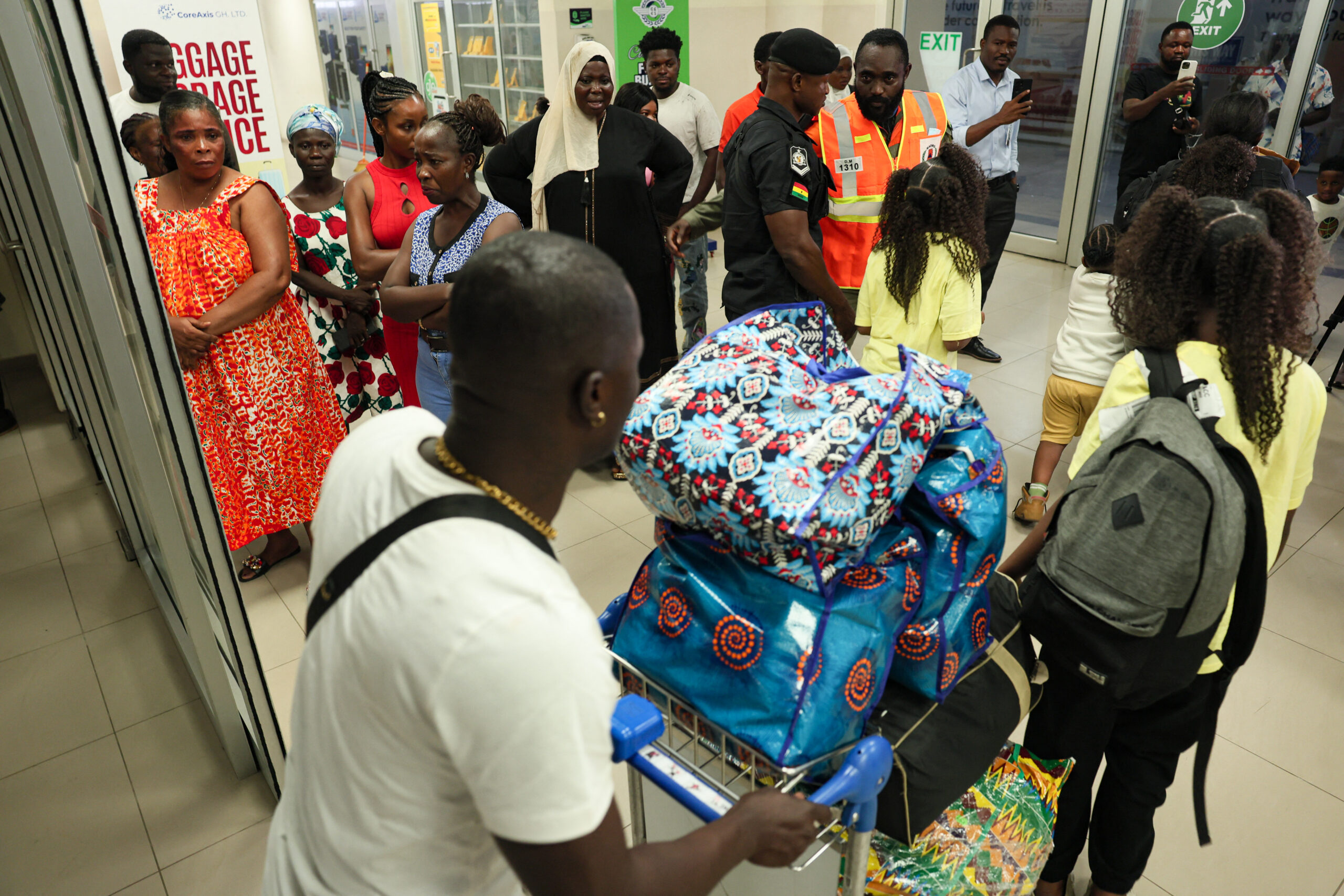
On Wednesday 27 May a flight carrying nearly 300 Ghanaians landed in Accra (pictured). Rather than a joyful homecoming, the overriding feeling for many was relief. The men, women and children had left South Africa quickly following a fresh wave of anti-migrant protests.
Ghana’s High Commissioner in South Africa, Benjamin Quashie, summed up the predicament of his compatriots, some of whom were undocumented: “The Ghanaian government listened to the plight of its citizens in South Africa, who felt that their lives were in danger, who felt like the economic activity that they were engaging in had come to a standstill, who felt unwelcome in this country,” he told the BBC.
The extent of the violence is contested. It prompted a statement from UN secretary-general António Guterres on South Africa’s Freedom Day, 27 April.
“The Secretary‑General is deeply concerned by reports of xenophobic attacks and acts of harassment and intimidation against migrants and foreign nationals in parts of South Africa, including in KwaZulu‑Natal and Eastern Cape Province. He strongly condemns these criminal acts perpetrated by individuals inciting violence and exploiting socio-economic conditions,” a spokesperson said.
On 8 May, in a terse statement after Ghana called for an African Union debate on the topic, the South African government referred to “sporadic incidents of confrontation against some immigrants… by sections in our communities earlier this month”.
It said it had directed agencies to uphold the law and arrest perpetrators and said that there was “no credible evidence… at this stage” that nationals from Ghana and Nigeria “were killed during the recent protests by law enforcement authorities”.
But on 20 May the NGO Human Rights Watch claimed that attacks targeting Africans and Asians had been met with “little or insufficient apparent response from the police and other authorities”.
While it has not verified reported cases of foreign nationals killed by vigilantes, it said a credible source had described the death of a Malawian at police hands.
The paradox facing South Africa
The chilling reality of periodic violence against African citizens is a paradox that the “Rainbow Nation” has failed to come to terms with. South Africa, whose elites espouse pan-African solidarity, has been a generous host. The government estimates that South Africa hosts approximately three million migrants, 90% of whom are Africans. Many have fled war, persecution and economic collapse to build peaceful, successful and deeply integrated lives.
For many well-to-do South Africans, life without such migrants – whether the Uber driver or domestic worker – is unthinkable. But at the other end of the social scale, migration has fed toxic resentment. The legacy of apartheid – the grinding hopelessness of township life, compounded by limited growth, mass joblessness and corruption under successive ANC administrations – has provided fertile ground for vigilantes. It is all too easy to portray the local spaza shop retailer or day labourer as illegitimate competitors for scarce opportunities and resources.
A dysfunctional Home Affairs department has aggravated the situation, leaving migrants in undocumented limbo and inviting others to chance the country’s porous borders.
But perhaps the most significant contributor to tensions is the failure of economic growth. The IMF expects GDP growth of just 1% this year – well below what is needed to keep up with unemployment. Promising if belated reform efforts have been overshadowed by global crises – Covid-19, trade tensions and now the war in the Middle East. As a result, anti-migrant forces are on the march again. A movement calling itself March and March has led major demonstrations and set a sinister “deadline” of 30 June for undocumented migrants to leave the country, after which it says it will trigger a nationwide shutdown.
As the global economy stutters, South Africa is not alone in dealing with xenophobia. But its toxic history of social exclusion and mass poverty leaves it especially combustible during economic stress. Only a government that doubles down on growth, reforms the defective immigration system and bolsters law enforcement can ensure that South Africa lives up to its best image of itself.